Key Takeaways
- Coverage isn’t the same as quality. Once you’ve found AHCCCS rehab facilities that will pay for your care, use nine specific questions—covering accreditation, continuum of care, dual diagnosis treatment, staffing, therapies, specialized programming, aftercare, billing, and clinical access—to tell the good programs from the merely adequate ones.
- How a facility answers matters as much as what it says. Vague responses, deflection to marketing language, refusal to share a staff-to-client ratio, or pressure to commit before verifying insurance are all warning signs worth taking seriously.
- Integrated care and real aftercare drive lasting outcomes. Look for a full continuum of care, dual diagnosis treatment for co-occurring mental health disorders, and structured alumni support—not just a discharge date.
- Verifiable credentials build trust. Multiple national accreditations (like The Joint Commission, LegitScript, and BBB) and a willingness to connect you with a clinician before you decide signal a program confident in its own quality.
Making a Care Decision With Confidence
Question:
How do I choose between rehab facilities that both accept AHCCCS?
Answer:
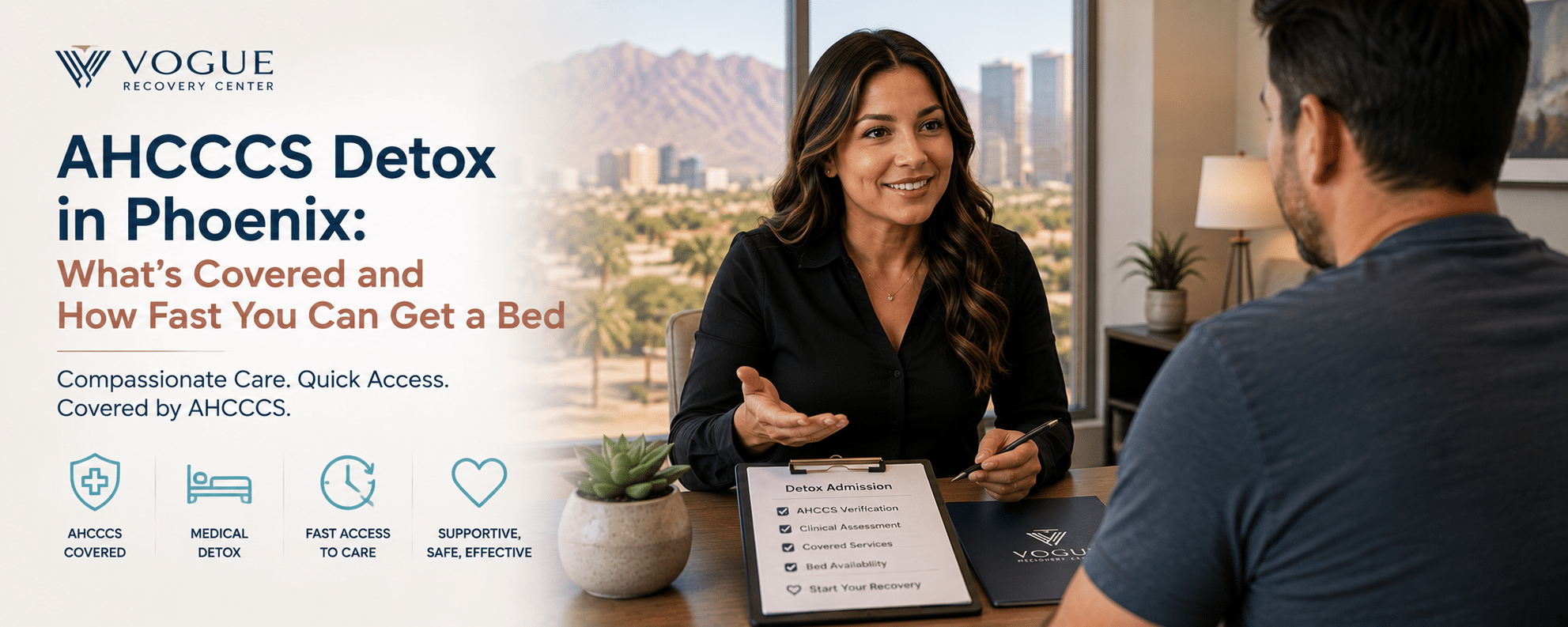
Choosing between AHCCCS rehab facilities is difficult when every program uses the same “compassionate, evidence-based” language. Coverage tells you what you can afford, not which facility will actually help you recover. This guide provides a nine-question script to run on any AHCCCS-approved rehab facility: ask about accreditations, continuum of care, co-occurring mental health treatment, staff-to-client ratio, evidence-based therapies, specialized programming for groups like veterans and LGBTQIA clients, aftercare and alumni support, insurance and AHCCCS billing, and whether you can speak to a clinician before deciding. The quality and directness of each answer separates good facilities from adequate ones. The post also explains how to spot evasive answers—deflection to marketing language, vague accreditation claims, pressure to commit quickly, and one-size-fits-all descriptions. Readers finish with a practical framework to compare covered options confidently and choose a facility for a clear reason. Vogue Recovery Center invites readers to test every question against its Phoenix admissions team.
You’ve done the hard part. You’ve found two or three AHCCCS rehab facilities that will cover your treatment, and now you’re staring at your options with a familiar question: how do I actually tell them apart? When every facility says it offers “compassionate, evidence-based care,” the marketing language starts to blur together. Coverage tells you what you can afford. It doesn’t tell you which program will help you build a lasting recovery.
That’s the gap this guide fills. Below are nine questions you can ask any AHCCCS rehab center—word for word—to separate the programs doing quality work from the ones that are merely adequate. You’ll also learn how to spot evasive answers, because sometimes what a facility won’t tell you matters more than what it will.
This isn’t about finding a perfect facility. It’s about picking one for a reason, with confidence, instead of choosing at random and hoping for the best. If you’re weighing your options for a rehab that takes AHCCCS, these questions give you a framework grounded in what actually drives outcomes.
Question 1: What accreditations do you hold?
Accreditation is the clearest signal of quality you can verify before you ever walk through the door. Ask specifically about The Joint Commission, which awards a “gold standard” certification achieved by only about 10% of healthcare providers nationally. Also ask whether the facility is LegitScript certified and accredited by the Better Business Bureau.
Why this matters: accreditation means an outside body has audited the facility’s clinical practices, safety standards, and quality assurance. A program that holds these credentials has invited scrutiny and passed. A program that dodges the question, or points only to a state license, may be meeting the minimum rather than exceeding it.
Choose a facility with multiple accreditations if independent verification of care quality matters to you—and for a decision this important, it should. Vogue Recovery Center, for example, is accredited by The Joint Commission, LegitScript certified, and accredited by the Better Business Bureau across all its treatment centers.
Question 2: What does your continuum of care look like?
Recovery rarely happens in a single level of care. The strongest AHCCCS approved rehab facilities offer a full continuum, so you can step down gradually as your stability grows instead of being discharged all at once.
A complete continuum of care includes:
- Medical detox with 24/7 supervision
- Residential (inpatient) treatment for structured, immersive care
- Partial hospitalization program (PHP) for daytime treatment while living at home or in sober living
- Intensive outpatient program (IOP) as you ease back into work and daily life
- Outpatient program (OP) for ongoing, flexible support
- Sober living to bridge treatment and independent life
When a facility offers every level under one roof, you don’t have to start over with a new team each time your needs change. That continuity protects your progress. Ask the facility to walk you through how a client typically moves from one level to the next—and what happens if you need to step back up.
Question 3: Do you treat co-occurring mental health disorders?
This question separates good facilities from adequate ones faster than almost any other. Co-occurring disorders—also called dual diagnosis—affect nearly half of all people with substance use issues. If a program treats only the addiction and ignores the anxiety, depression, trauma, or PTSD underneath it, you’re only getting half the care you need.
Ask directly: “Are you a dual diagnosis treatment center, and how do you address mental health alongside addiction?” A quality program will describe integrated treatment, where mental health care and substance abuse care happen together, not in separate silos.
This is essential if you’ve struggled with mental health symptoms, past trauma, or relapse after treatment that only addressed the substance. Look for facilities that offer trauma-focused therapies and psychiatric support as core parts of the program, not add-ons.
Question 4: What is your staff-to-client ratio?
A low staff-to-client ratio is one of the most practical predictors of the attention you’ll actually receive. It’s the difference between a counselor who knows your name and your history and one who’s stretched across too many people to notice when you’re struggling.
Ask for a specific number. A strong AHCCCS rehab center will give you one without hesitation—Vogue Recovery Center’s Phoenix location, for instance, maintains a 5:1 staff-to-guest ratio with 24-hour registered nurses and clinicians. A vague answer (“we keep it small,” “it depends”) is worth a gentle follow-up: “Can you give me the actual number?”
The more individualized your care, the more your treatment plan can be built around you rather than a template.
Question 5: What evidence-based therapies do you offer?
“Evidence-based” is a phrase every facility uses, so make them show their work. Ask which specific modalities their clinical team is trained in. A well-rounded program should be able to name several, such as:
- Cognitive behavioral therapy (CBT)
- Dialectical behavior therapy (DBT)
- Acceptance and commitment therapy (ACT)
- Cognitive processing therapy (CPT)
- Eye movement desensitization and reprocessing (EMDR)
- Motivational interviewing (MI)
- Trauma-focused CBT
Strong programs also blend these traditional therapies with holistic and experiential options—art therapy, music therapy, yoga, and mindfulness—so you can find what resonates with you. The goal isn’t the longest list. It’s a thoughtful mix delivered through individual, group, and family therapy, matched to your needs.
If you’re seeking AHCCCS drug rehab or AHCCCS alcohol rehab specifically, ask how their therapy approach adapts to the substance and severity involved. Treatment for alcohol addiction and drug addiction shares a foundation, but the details should be tailored.
Question 6: Do you offer specialized programming for veterans, LGBTQIA clients, or dual diagnosis?
Recovery isn’t one-size-fits-all, and the best facilities know it. If you belong to a community with specific needs, ask whether the program has dedicated, trained support for it.
A few examples worth asking about:
- Veterans and first responders: Around 1 in 15 veterans struggles with substance abuse, and PTSD prevalence among those meeting criteria for both alcohol and drug use disorders is 76%. Specialized, trauma-focused tracks—like Vogue Recovery Center’s Valor Program—address these unique experiences in a setting alongside peers who understand them.
- LGBTQIA clients: Discrimination and identity-related trauma can fuel substance use. Look for staff trained to create affirming, non-judgmental spaces.
- Dual diagnosis: As covered above, integrated care for co-occurring conditions should be a specialty, not an afterthought.
Choose a facility with specialized programming if your background or identity has shaped your relationship with substances. Treatment that acknowledges your specific experience tends to land deeper than generic care.
Self-Assessment: Am I Addicted?
"*" indicates required fields
Contact Us
Ready to Get Help? Get in Touch Today.
"*" indicates required fields
Question 7: What does aftercare and alumni support look like?
Treatment doesn’t end at discharge—that’s often when the real test begins. A network of sober peers is one of the strongest predictors of long-term recovery, so ask what happens after you complete the program.
Good answers include structured aftercare planning that connects you with therapists, psychiatrists, support groups, and resources before you leave. Ask, too, about the alumni community. Vogue Recovery Center’s Rising Phoenix alumni program, for example, offers weekly meetings, regular outings, monthly dinners, and a dedicated online community that welcomes graduates from any of its locations for life.
A facility that treats aftercare as an afterthought is telling you something about how it views your recovery beyond the billable weeks. The strongest programs build a bridge to lasting sobriety, not just a discharge date.
Question 8: How do you handle insurance verification and AHCCCS billing?
The last thing you need while entering treatment is confusion about coverage. A quality facility makes this part simple. Ask whether they’re in-network with AHCCCS (Arizona’s Medicaid program) and whether they’ll verify your benefits for you.
The right answer sounds like this: yes, we’re in-network, and we’ll contact AHCCCS directly, review exactly what your plan covers, and explain any potential out-of-pocket costs before you commit. Vogue Recovery Center is in-network with AHCCCS and offers free insurance verification so you understand your coverage upfront.
If a facility is vague about whether they truly accept AHCCCS, or pressures you to commit before confirming coverage, treat that as a warning sign. Transparency about money reflects transparency about everything else.
Question 9: Can I speak to someone on your clinical team before I decide?
This final question is a quiet stress test. Any facility can put a polished admissions coordinator on the phone. Fewer will let you speak with a clinician—a nurse, counselor, or clinical director—before you’ve committed to anything.
Ask for it anyway. A brief conversation with someone who will actually be part of your care tells you more than any brochure. You’ll get a feel for their expertise, their tone, and whether they treat your questions with patience or impatience. A program confident in its clinical team will welcome the request.
If you’re comparing an AHCCCS rehab in Phoenix, this is also your chance to ask location-specific questions about the Phoenix facility, its detox process, and what a typical day looks like.
How to spot evasive answers
Sometimes the most useful information is in how a facility answers, not just what it says. Watch for these patterns as you work through your nine questions:
- Deflecting to marketing language. If you ask for a staff-to-client ratio and get “we pride ourselves on personalized care” instead of a number, press once more. Real programs have real numbers.
- Vagueness about accreditation. “We’re fully licensed” is not the same as naming specific accreditations. A quality facility will name them proudly.
- Pressure to commit quickly. Urgency around your decision—especially before insurance is verified—is a red flag. Recovery is a serious decision, and a good program respects your need to make it carefully.
- No path to a clinician. If you can only ever reach sales-focused staff, ask why.
- One-size-fits-all descriptions. If every answer sounds like it could apply to anyone, the treatment may be just as generic.
None of these alone should disqualify a facility. But a pattern of them tells you a lot about how you’ll be treated once you’re a client rather than a prospect.
Put these nine questions to work
Choosing between covered options doesn’t have to feel like guesswork. When you run these nine questions on every AHCCCS rehab center you’re considering, the differences that matter—accreditation, integrated mental health care, staff attention, real aftercare—come into focus quickly. You move from “they all sound the same” to “here’s why I chose this one.”
You deserve to make this decision for a reason. So use the script. Ask hard questions, listen closely to the answers, and trust the facility that responds with clarity, patience, and specifics.
Run these nine questions on our admissions team—and on everyone else you’re considering. Vogue Recovery Center is in-network with AHCCCS in Phoenix, holds multiple national accreditations, and offers a full continuum of care with dual diagnosis treatment and lifelong alumni support. Reach out to our admissions team or learn more about our AHCCCS rehab program to see how we answer every one.
Frequently asked questions
Does AHCCCS cover rehab in Arizona?
Yes. AHCCCS, Arizona’s Medicaid program, covers substance use disorder treatment, and federal parity laws require most insurers to treat addiction care the same as other medical conditions. Coverage specifics depend on your plan and the level of care you need. A free insurance verification can confirm exactly what’s covered before you begin.
How do I choose an AHCCCS rehab facility when I have more than one option?
Run the same nine questions on each facility: accreditation, continuum of care, dual diagnosis treatment, staff-to-client ratio, evidence-based therapies, specialized programming, aftercare, insurance handling, and clinical team access. Compare the answers side by side. The facility that responds with specifics and transparency—rather than marketing language—is usually the stronger choice.
What’s the difference between a good AHCCCS rehab and an adequate one?
An adequate facility meets minimum standards: it’s licensed, and it accepts your coverage. A good facility exceeds them—holding multiple national accreditations, treating co-occurring mental health disorders, maintaining a low staff-to-client ratio, offering a full continuum of care, and providing robust aftercare. The nine questions in this guide are designed to reveal which category a facility falls into.
Are AHCCCS-approved rehab facilities lower quality than private-pay ones?
Not necessarily. Coverage type doesn’t determine care quality—accreditation, clinical staffing, and program design do. Many AHCCCS-approved rehab facilities hold the same national accreditations and offer the same evidence-based therapies as private-pay programs. That’s exactly why running these nine questions matters: they measure quality directly, regardless of how treatment is paid for.
How quickly should I decide on a rehab facility?
Quickly enough to get help without delay, but not so fast that you skip your due diligence. A reputable facility will verify your insurance, answer your questions, and let you speak with a clinician without pressuring you to commit on the spot. If a program rushes you before confirming coverage or answering your questions, consider that a warning sign.
References:
- Arizona Health Care Cost Containment System – https://www.azahcccs.gov/
- Centers for Disease Control and Prevention. (2024, April 24). Treatment of substance use disorders. Centers for Disease Control and Prevention. https://www.cdc.gov/overdose-prevention/treatment/index.html
-
 View all posts
Content Writers
At Vogue Recovery Center, we make information about addiction clear and easy to understand, no matter your familiarity with the topic. With expertise in addiction and recovery, the Vogue Recovery Editorial Staff creates content that’s engaging, informative, and relatable. Whether you’re exploring treatment options or the science of addiction, our blog has you covered. We share evidence-based insights on substance abuse and mental health from trusted sources.