Key Takeaways
- AHCCCS covers inpatient rehab when it’s medically necessary—including detox, residential, PHP, and outpatient care—for eligible Arizona residents at little to no out-of-pocket cost.
- Qualifying comes down to a clinical assessment based on the ASAM criteria, which evaluate six dimensions of your life: withdrawal risk, physical health, mental health, readiness to change, relapse potential, and recovery environment.
- Having tried outpatient or detox without lasting success strengthens your case for a residential bed—honest, specific descriptions of relapse, dangerous withdrawal, co-occurring conditions, and an unstable home environment all support medical necessity.
- Vogue Recovery Center Arizona is an AHCCCS-accepted inpatient rehab in Phoenix, offering a full continuum of care, dual diagnosis treatment, and a free clinical assessment to determine which level of care your plan will authorize.
Making a Safe, Informed Treatment Decision
Question:
How can I qualify for inpatient rehab in Arizona with AHCCCS?
Answer:
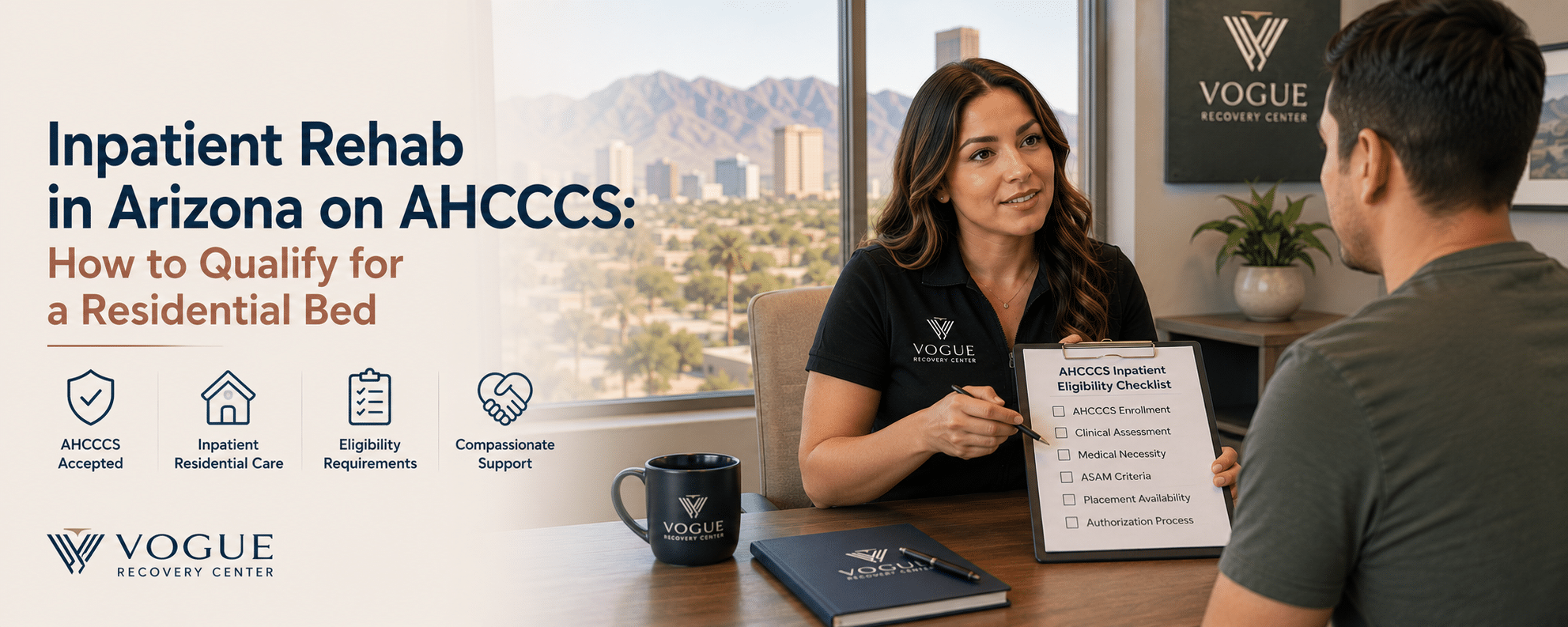
This guide explains how to qualify for an AHCCCS-covered inpatient rehab bed in Arizona, written for people who’ve tried outpatient treatment or detox alone and still need a higher level of care. It confirms that AHCCCS—Arizona’s Medicaid program—covers residential addiction treatment when it’s medically necessary, and clarifies that qualifying depends on a clinical assessment using the ASAM criteria. The post breaks down the six ASAM dimensions in plain language, so readers can describe their situation to an assessor in terms that accurately reflect their needs. It lists specific signals that support medical necessity for residential care, walks through what to expect during a clinical assessment, and validates why outpatient alone often isn’t enough. Finally, it introduces Vogue Recovery Center Arizona, an AHCCCS-accepted inpatient rehab in Phoenix offering detox, residential care, and dual diagnosis treatment, and encourages readers to schedule a free clinical assessment to find out what their plan will authorize.
If you’ve already tried outpatient treatment or a detox stay and found yourself right back where you started, you’re not failing at recovery. You may simply need a higher level of care than you’ve been getting. That’s a clinical reality, not a personal shortcoming—and it’s exactly the situation residential rehab is built for.
The hard part is often the paperwork. Many people don’t realize that qualifying for an AHCCCS-covered residential bed comes down to meeting a specific “medical-necessity” bar. If you can describe your situation clearly and accurately to an assessor, you’re far more likely to get the level of care that actually helps.
This guide breaks down how AHCCCS coverage works, what the ASAM criteria mean in plain language, and how to walk into a clinical assessment prepared. By the end, you’ll know how to describe your circumstances in terms that reflect what you truly need—so you can find inpatient rehab centers in Arizona that accept AHCCCS and get started.
Does AHCCCS Cover Inpatient Rehab?
Yes. As a core benefit, addiction treatment AHCCCS covers substance use disorder care when a licensed provider determines it’s medically necessary. This includes medically supervised detox when medically necessary, residential (inpatient) treatment, partial hospitalization, and outpatient programs, and inpatient rehab coverage can include the facility stay and related treatment. Exact inpatient rehab options depend on your AHCCCS insurance plan and whether the treatment center is contracted with that plan.
The key phrase is medically necessary. AHCCCS doesn’t authorize a residential bed simply because you’d prefer one—it authorizes the level of care your clinical situation calls for. So the real question isn’t “does AHCCCS cover rehab?” It’s “how do I show that inpatient rehab is the right level of care for me?”
That’s what this guide is designed to help you do. When people ask whether AHCCCS covers inpatient rehab, they’re usually really asking how to get approved for it. The answer lies in understanding how level-of-care decisions are made—and how to describe your own experience honestly and completely during the assessment.
What Is AHCCCS and Who Qualifies?
AHCCCS stands for the Arizona Health Care Cost Containment System. It’s the state’s Medicaid program, providing health coverage—including behavioral health and addiction treatment—to eligible Arizona residents at little or no cost.
You may qualify for AHCCCS based on factors such as:
- Income: Most eligibility is tied to household income relative to the federal poverty level.
- Household size: The income limits adjust depending on how many people are in your home.
- Residency and citizenship: You must be an Arizona resident and meet citizenship or qualified immigration status requirements.
- Category: Certain groups—such as pregnant women, children, and adults under expansion coverage—may have different pathways to eligibility.
If you’re already enrolled in AHCCCS, you likely already have access to covered addiction treatment. If you’re not sure whether you’re enrolled or eligible, you can apply through the state or ask a treatment provider’s admissions team to help you check. Many people are surprised to learn they qualify for an AHCCCS rehab center at no out-of-pocket cost.
Federal law requires that behavioral health and substance use treatment be covered on par with other medical care. That’s why AHCCCS drug rehab and AHCCCS alcohol rehab services are treated as essential health benefits—not optional extras.
Understanding ASAM Criteria in Plain Language
When a clinician decides which level of care you need, they don’t guess. They use a national framework called the ASAM Criteria, developed by the American Society of Addiction Medicine. Nearly every provider offering rehab that takes AHCCCS relies on it.
The ASAM Criteria look at six areas of your life—called dimensions. Together, they paint a full picture of what you’re dealing with. Understanding these six dimensions gives you the language to describe your own situation accurately.
Dimension 1: Intoxication and Withdrawal
This looks at what happens when you stop using. Do you experience shakes, sweating, nausea, seizures, or intense cravings? Serious withdrawal risk—especially from alcohol or benzodiazepines—often points toward a need for medical detox and inpatient care.
Dimension 2: Biomedical Conditions
This covers your physical health. Chronic pain, liver problems, pregnancy, or other medical issues can make recovery more complicated and may require the round-the-clock support that residential treatment provides.
Dimension 3: Emotional and Behavioral Conditions
This dimension examines your mental health. Depression, anxiety, trauma, PTSD, or thoughts of self-harm all matter here. Co-occurring mental health conditions are common, and they often strengthen the case for a higher level of care.
Dimension 4: Readiness to Change
This looks at where you are emotionally with recovery. It’s okay to feel unsure or ambivalent—honesty here helps your assessor understand how much structure and support you need.
Dimension 5: Relapse and Continued-Use Potential
This is where “I’ve tried outpatient and it didn’t work” carries real weight. If you’ve relapsed after detox or struggle to stay sober in your day-to-day environment, that history signals a strong need for inpatient care.
Dimension 6: Recovery Environment
This looks at your surroundings. Do you live with people who use? Is your home stressful, unstable, or full of triggers? An unsupportive environment is one of the clearest reasons a residential bed may be authorized.
The takeaway: the more honestly and completely you describe your experience across these six dimensions, the more accurately your assessor can match you with the care you need.
How to Meet the Medical-Necessity Bar for Residential (Level 3)
Residential treatment is known as ASAM Level 3—24-hour behavioral health services in a live-in setting under AHCCCS. To qualify for a residential rehab Arizona AHCCCS bed, your assessment needs to show that a lower level of care isn’t enough to keep you safe or support your recovery.
Inpatient care and residential treatment under AHCCCS generally require prior authorization based on medical necessity.
Here are specific signals that often support medical necessity for inpatient care. If any of these describe you, say so clearly during your assessment:
Here are specific signals that often support medical necessity for inpatient care. If any of these describe you, say so clearly during your assessment:
- You’ve relapsed after outpatient or detox. Repeated returns to use after lower levels of care are strong evidence you need more structure.
- Your withdrawal symptoms are dangerous or unmanageable at home. Seizures, severe shakes, hallucinations, or a history of complicated withdrawal all matter.
- You have a co-occurring mental health condition. Depression, anxiety, trauma, or suicidal thoughts alongside substance use often require integrated, 24-hour support.
- Your home environment makes sobriety nearly impossible. Living with active substance use, abuse, or constant triggers can undermine any outpatient plan.
- You can’t stay sober long enough to benefit from outpatient care. If you’re using between sessions, you may need the distance and structure residential provides.
- You have medical conditions that complicate recovery. Pregnancy, chronic illness, or other health concerns can require closer monitoring.
You don’t need to exaggerate or perform a crisis. You simply need to tell the truth about how hard this has been. Many people minimize their struggles out of shame or habit—and that can accidentally result in being placed in a level of care that’s too low to help.
Self-Assessment: Am I Addicted?
"*" indicates required fields
Contact Us
Ready to Get Help? Get in Touch Today.
"*" indicates required fields
What Happens During the Clinical Assessment?
The clinical assessment is a conversation, not a test. A licensed professional will ask about your substance use history, physical and mental health, past treatment, living situation, and current symptoms. They’re gathering the information needed to match you with the right level of care—and to document medical necessity for your AHCCCS plan.
Here’s what you can generally expect:
- A conversation about what brought you in. You’ll talk about your substance use and what’s been happening lately.
- A review of your history. This includes past treatment attempts, medical conditions, mental health, and any previous withdrawal experiences.
- Questions about your daily life. Your living environment, support system, and responsibilities all factor into the recommendation.
- A level-of-care recommendation. Based on the ASAM dimensions, the clinician recommends detox, residential, PHP, IOP, or outpatient care.
- Insurance verification. The admissions team confirms your AHCCCS coverage and what your plan will authorize.
To prepare, it helps to think through your answers ahead of time. Jot down when you last used, what your withdrawal symptoms feel like, how many times you’ve tried to quit, and what your home situation is like. The more specific you are, the more accurately the assessor can advocate for the care you need.
Why Outpatient Alone May Not Be Enough
If you’re reading this, there’s a good chance you’ve already tried the lower-intensity options. Maybe you completed a detox and felt great for a week—then slipped back. Maybe you’ve been attending outpatient sessions while still living in the same environment that fuels your use.
That experience is incredibly common, and it doesn’t mean you’re doing recovery wrong.
Outpatient treatment works well for many people—especially those with strong support at home and less severe substance use. But it asks you to stay sober in the same environment where your addiction took hold. For someone facing severe cravings, dangerous withdrawal, co-occurring mental health struggles, or an unstable home, that’s a lot to ask.
Residential treatment removes those obstacles. It gives you distance from triggers, 24-hour support, and space to focus entirely on getting well. For people who’ve cycled through detox or outpatient without lasting results, a higher level of care often makes the difference between another relapse and real, lasting recovery.
Recovery isn’t about willpower alone. It’s about getting the right level of care for where you actually are—and there’s no shame in needing more.
Vogue Recovery Center Arizona: AHCCCS-Accepted Inpatient Rehab
Vogue Recovery Center Arizona is an AHCCCS-accepted treatment provider offering inpatient rehab in Phoenix. Located at 4122 N 17th St, Phoenix, AZ 85016, Vogue Recovery Center Arizona is in-network with AHCCCS, making it one of the inpatient rehab centers in Arizona that accept AHCCCS for both detox and residential care.
Vogue Recovery Center Arizona holds accreditations that reflect a high standard of care, including:
- Gold Seal accreditation from The Joint Commission—a standard achieved by only about 10% of healthcare providers nationally
- LegitScript certification
- Better Business Bureau accreditation
At its Phoenix rehab location, Vogue Recovery Center Arizona offers a full continuum of care, so you can move between levels as your needs change:
- Medical detox with 24/7 nursing and medication support to manage withdrawal safely
- Residential (inpatient) treatment with semi-private rooms, 24-hour nursing, and a 5:1 staff-to-guest ratio
- Partial hospitalization program (PHP) for structured daytime care
- Intensive outpatient program (IOP) and traditional outpatient for step-down support
- Sober living residences to support the transition back to daily life
Vogue Recovery Center Arizona specializes in dual diagnosis treatment, addressing addiction alongside co-occurring mental health conditions like depression, anxiety, and trauma. The Phoenix team also offers specialized programming for veterans and first responders through its Valor Program, as well as an affirming, dedicated track for LGBTQIA guests.
Whether you’re seeking AHCCCS drug rehab or AHCCCS alcohol rehab, Vogue Recovery Center Arizona provides trauma-focused, evidence-based care in a welcoming, home-like setting. You can learn more about the Phoenix rehab location or explore how AHCCCS rehab coverage works at Vogue.
How to Get Started
The clearest way to find out whether your plan will authorize a residential bed is to complete a clinical assessment. It’s free, confidential, and it’s the step that turns “I think I need inpatient care” into a documented, actionable recommendation.
Here’s how to begin:
- Schedule a free clinical assessment. A licensed clinician will complete an ASAM-based evaluation and recommend the right level of care for your situation. Start through the admissions process.
- Verify your AHCCCS coverage. The admissions team will confirm your benefits and what your plan will authorize. You can begin with free insurance verification.
- Get matched to a level of care. Based on your assessment, you’ll receive a recommendation—and if inpatient is appropriate, help arranging your stay.
If your struggle has been with drinking, you can learn more about alcohol addiction treatment. If drugs are the primary concern, explore options for drug addiction treatment. Either way, an Arizona rehab that takes AHCCCS can help you find the right path forward.
You Deserve the Care That Actually Works
Trying outpatient or detox and still struggling doesn’t mean recovery isn’t possible for you. It often means you simply need a higher level of care—and now you know how to describe your situation in terms that reflect that need.
AHCCCS does cover inpatient rehab when it’s medically necessary. The ASAM criteria give you a clear framework for explaining your experience, and a free clinical assessment turns that conversation into an authorized level of care. You don’t have to figure out the paperwork alone.
If you’re ready to take the next step, schedule a free clinical assessment to find out which level of care your plan will authorize. The right support is within reach—and you deserve to get well.
Frequently Asked Questions
Does AHCCCS cover inpatient rehab in Arizona?
Yes. AHCCCS covers inpatient and residential addiction treatment when a licensed provider determines it’s medically necessary. Coverage typically includes medical detox, residential treatment, partial hospitalization, and outpatient programs. A clinical assessment based on the ASAM criteria determines which level of care your plan will authorize.
How do I qualify for a residential (inpatient) bed on AHCCCS?
You qualify by completing a clinical assessment that shows inpatient care is medically necessary. This usually means demonstrating that a lower level of care isn’t enough—for example, you’ve relapsed after outpatient or detox, have dangerous withdrawal symptoms, face co-occurring mental health conditions, or live in an environment that makes sobriety nearly impossible.
What are the ASAM criteria?
The ASAM Criteria are a national framework from the American Society of Addiction Medicine used to match people with the right level of addiction care. They assess six dimensions: withdrawal risk, physical health, mental health, readiness to change, relapse potential, and recovery environment. Providers offering AHCCCS rehab use these criteria to determine medical necessity.
How much does AHCCCS rehab cost?
For eligible Arizona residents, AHCCCS covers addiction treatment at little to no out-of-pocket cost. Because it’s the state’s Medicaid program, covered services—including detox and residential care—are treated as essential health benefits. A free insurance verification can confirm exactly what your specific plan covers.
What if I’ve already tried outpatient and it didn’t work?
That’s one of the clearest signals that you may need a higher level of care. Relapsing after outpatient or detox is common and carries real weight under the ASAM criteria—specifically the dimension covering relapse potential. Be sure to describe this history honestly during your assessment, as it strongly supports the case for inpatient treatment.
Where can I find an AHCCCS rehab in Phoenix?
Vogue Recovery Center Arizona is an AHCCCS-accepted inpatient rehab located in Phoenix at 4122 N 17th St. It offers medical detox, residential treatment, PHP, IOP, outpatient care, and sober living, along with dual diagnosis treatment and specialized programs for veterans, first responders, and LGBTQIA guests.
References:
- Arizona Health Care Cost Containment System – https://www.azahcccs.gov/
- Centers for Disease Control and Prevention. (2024, April 24). Treatment of substance use disorders. Centers for Disease Control and Prevention. https://www.cdc.gov/overdose-prevention/treatment/index.html
-
 View all posts
Content Writers
At Vogue Recovery Center, we make information about addiction clear and easy to understand, no matter your familiarity with the topic. With expertise in addiction and recovery, the Vogue Recovery Editorial Staff creates content that’s engaging, informative, and relatable. Whether you’re exploring treatment options or the science of addiction, our blog has you covered. We share evidence-based insights on substance abuse and mental health from trusted sources.